Recruitment in the IT sector right now is a challenge. CVs and applications might pour in for every job listing you post. But after two rounds of interviews, a few assessments, and more “we’ll get back to you” emails than you’d like to admit, you might realise something.
No one quite fits your mould for the perfect candidate.
You’re not alone. 75% of employers say they struggle to find the right candidates – even as their inboxes overflow with applications.
Welcome to the Great Mismatch, where job openings and job seekers are both on the rise, but somehow, nothing is aligned. The problem isn’t a lack of people. There’s a growing gap between the skills businesses need and the skills candidates bring.
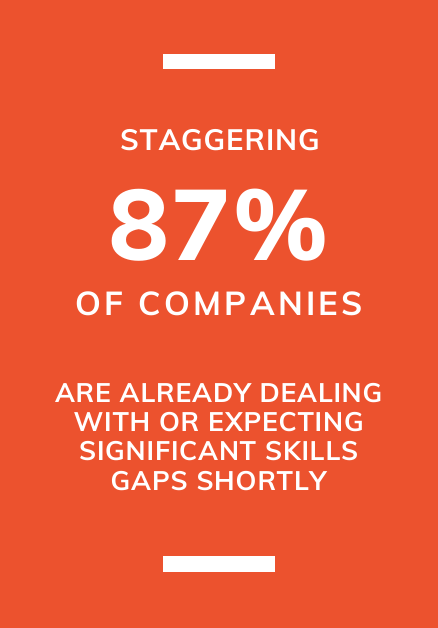
According to McKinsey, a staggering 87% of companies are already dealing with or expecting significant skills gaps shortly.
Here’s what is happening.
The talent and hiring shortages companies face today aren’t due to people “not wanting to work” or Gen Z culture problems.
The skills mismatch isn’t anyone’s fault, but it is everyone’s problem.
The gap between what companies need and what candidates can do is growing wider, and if we want to fix it, we must get real about why it’s happening.
So what are some of the root causes?
The shelf life of a hard skill these days is about five years and shrinking. That course someone took in 2020 is probably already out of date. The platforms your team relies on today didn’t even exist ten years ago. AI, automation, cloud computing, and data analytics skills are becoming crucial – but there aren’t enough people who have them yet.
Traditional education isn’t keeping up. Universities and training programs produce graduates with degrees, but not always with the practical, job-ready skills employers need.
Systems designed for slow, stable economies are trying to serve a workforce where IT jobs are being created and reinvented in real time. According to the World Economic Forum, up to 59% of workers worldwide must retrain by 2030.
Economic volatility isn’t helping. We have uncertain inflation rates, shifting trade policies, wage pressure, labour shortages in some sectors and oversupply in others.
Many businesses are pausing on long-term hiring plans. Others are hiring cautiously, with painfully specific requirements. Then there are geographic mismatches: the person with the exact skills you need might live in a different time zone entirely and might not be willing (or able) to relocate.
Industries evolve. That’s not new. But lately, it feels like they’re doing it overnight. Healthcare jobs now require digital skills. Manufacturing is becoming more automated. Marketing is data-driven.
When you can’t find the right IT talent, everything slows down, and the costs start stacking up.
Unfilled roles mean stalled projects, missed revenue, and heavier workloads for the still-standing team. Every month, a position stays vacant, reducing productivity, slipping deadlines, and causing your team to stretch thinner. Morale suffers, and burnout creeps in. Your best people start looking elsewhere.
Here’s the good news: the skills mismatch might feel overwhelming, but it’s not unfixable.
You don’t have to reinvent the wheel. You need to stop relying on the one that’s no longer working.
What can you do to handle this? Here are some ideas that are working now.
Instead of asking, “Where did this person go to school?” or “How many years have they done X?”, start asking, “Can they do the job?”
Skills-based hiring focuses on demonstrated ability, not degrees or job titles. It’s about identifying what success in the IT role requires, and then looking for people who can deliver that, whether they’ve worked in your industry or not.
Use modern assessment platforms to measure real-world skills, from coding and data analysis to problem-solving and communication. During interviews, ask candidates to walk you through how they’d handle challenges your team faces.
If you’re only looking in the same places, it’s no wonder you're finding the same results. One reason the IT skills gap feels so insurmountable is because most companies are fishing in very small ponds, same platforms, same requirements, same networks.
Look for transferable skills from other industries. A retail manager might have top-tier leadership and customer service abilities that translate beautifully into ops or support roles.
The tech talent you need might already be sitting in your office.
Instead of endlessly searching for external hires, what if you looked inside your company and asked: Who has the foundation to grow into this role?
Upskilling (building on current skills) and reskilling (teaching someone something new) are lifelines. According to the World Economic Forum, 95% of at-risk workers could be retrained for future roles cost-effectively. Here’s how you can start:
Training isn’t just a retention tool; it’s also a growth strategy.
Sometimes the problem isn’t the talent. It’s the process.
You can have the best job in the world, but if your application takes 40 minutes, your interview loop drags on for weeks, or you go dark after the final round, great candidates will walk.
You need a clear, fast, and respectful hiring process to attract and retain top IT talent, especially in a competitive, skills-short market.
Your hiring process is part of your employer brand. Make sure it sends the message you want.

The skills mismatch will not disappear on its own. But with the right strategy, it is solvable.
The companies that succeed tomorrow are the ones making smart moves today. They’re investing in their people. They’re hiring based on what someone can do, not just what’s written on a diploma. They’re building flexibility into their hiring systems, and adaptability into their culture.
So, where do you start?
Run that skills audit, rewrite one job description, and talk to your team about what growth looks like for them. Small shifts lead to big results.
And if you’re ready to build a more resilient, future-ready workforce that can handle what’s next, no matter what that looks like, we’ve got your back.
Let’s close the gap.